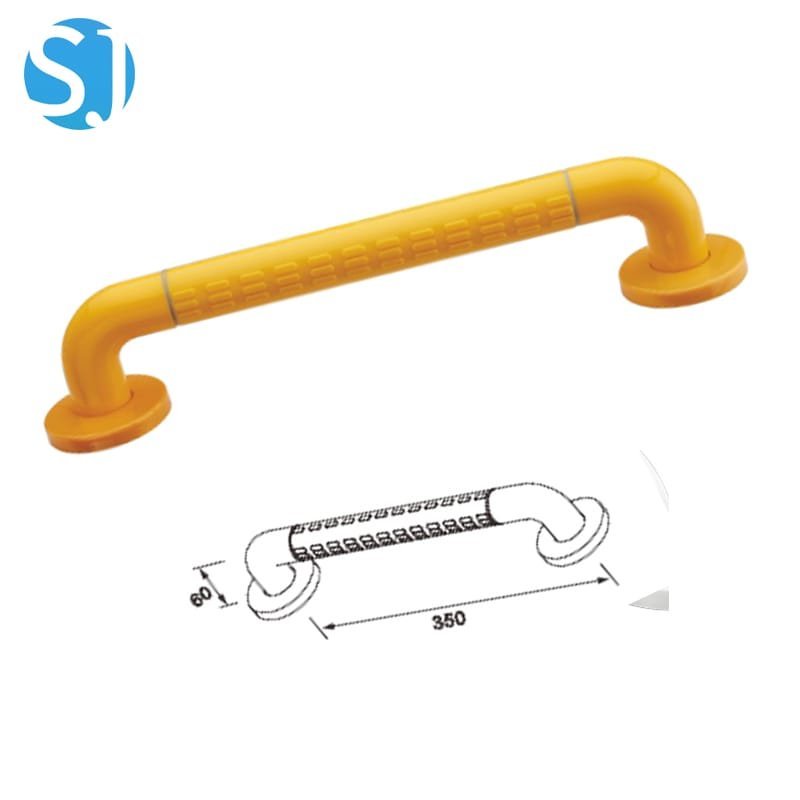
Product Features
· Straight horizontal profile — the most versatile grab bar configuration; mounts horizontally or at a slight angle on any bathroom wall surface
· Stainless steel inner core + antibacterial nylon coating — structural load-bearing performance of steel with the warm touch, grip and hygiene properties of nylon
· Antibacterial nylon surface — continuous bacterial inhibition on the bar surface; critical for clinical environments with high patient contact frequency
· Warm to the touch — nylon surface maintains comfortable temperature even in unheated bathrooms; encourages full grip by patients with cold sensitivity or arthritis
· Slip-resistant when wet — nylon texture maintains friction under wet hand conditions; more grip-consistent than polished stainless steel
· 35mm diameter (32–38mm optional) — within the ADA and EN standard graspable diameter range for users with limited hand strength
· 150 kg minimum load capacity — structural inner core supports bariatric users
· Concealed installation — wall flange covers mounting screws for a clean clinical finish
· Custom lengths — standard 300–900mm; custom lengths available for non-standard bay dimensions
· Color options — white (standard), yellow, ivory, custom RAL
Product Specifications
| Model | GB-001 |
| Type | Straight nylon grab bar |
| Inner core | Stainless steel tube |
| Outer coating | Antibacterial nylon |
| Diameter | 35mm standard (32–38mm optional) |
| Standard lengths | 300 / 400 / 500 / 600 / 700 / 800 / 900mm |
| Custom lengths | Available on request |
| Load capacity | ≥150 kg |
| Wall clearance | 38mm (bar surface to wall face) |
| Mounting | Wall-mounted, concealed screw flanges |
| Colors | White (standard), yellow, ivory, custom RAL |
| Standards | ADA compliant diameter and load specification |
| Applications | Hospital bathrooms, shower areas, toilet walls, nursing home wet rooms |
| MOQ | By quantity — project order |
| Lead time | 15–20 business days |
Applications
· Hospital bathroom and shower walls — primary shower support bar; mounted horizontally at 850–900mm height for standing shower use, or at 700–750mm for seated shower users
· Toilet area side support — mounted on the side wall beside the toilet at 840mm centerline height per ADA guidelines; provides support for sit-to-stand transfer
· Nursing home wet rooms — single-bar support for residents with partial mobility impairment who do not require a bilateral support system
· Rehabilitation center bathrooms — recovery-phase support for patients rebuilding strength and confidence in bathroom use
· Accessible public restrooms — general-purpose ADA-compliant support bar for accessible toilet stalls and shower facilities
· Residential accessible bathrooms — home modification support bar for elderly users aging in place
Installation Steps
1. Determine mounting height — per ADA Section 609, toilet grab bars mount at 33–36 inches (840–915mm) above the finished floor to the top of the bar. For shower bars, mount at 850–900mm for standing users or lower as specified by the occupational therapist for the patient.
2. Locate the structural wall substrate — use a stud finder to identify timber studs, or confirm concrete/masonry wall. All fixings must go into the structural substrate, not plasterboard alone. For tile walls, mark fixing positions on the tile surface.
3. Mark fixing hole positions — hold the GB-001 wall flanges against the wall at the determined height and mark through the flange screw holes onto the wall surface. Confirm level with a spirit level before marking.
4. Drill fixing holes — for masonry/concrete walls, use a masonry bit sized for the wall anchor. For tile walls, use a tile drill bit to penetrate the tile, then switch to a masonry or timber bit for the substrate behind. Drill to the anchor depth.
5. Insert anchors — insert appropriate wall anchors (stainless steel for wet areas). For timber studs, use stainless steel structural screws directly into the stud.
6. Mount the wall flanges — position each flange over the anchor holes and secure with the supplied stainless steel screws. Tighten firmly — do not overtighten, which may crack tiles.
7. Fit the bar — slide the grab bar between the flanges (or mount as per the specific flange design of the GB-001). Secure the bar connection at both flange ends per the installation instructions.
8. Apply flange covers — press the decorative cover caps onto each flange to conceal the mounting screws. The concealed-screw installation provides a clean finish and prevents screw-head corrosion in the wet environment.
9. Load test — before the bathroom is returned to use, apply a firm downward and outward load to the bar to confirm secure fixing. There should be no movement or flex at the wall flange connection.
Product Advantages
· Warm-touch clinical advantage — in elderly and clinical environments, the nylon surface temperature comfort encourages full-hand grip; a cold stainless steel bar in a chilly bathroom may be avoided by a patient who needs it most
· Antibacterial surface = passive infection control — in hospital bathrooms used by multiple patients per day, the continuous antibacterial action of the nylon surface reduces the colonisation risk between cleaning cycles; this is a clinical specification advantage that bare stainless steel cannot offer
· Concealed installation — the clean flange-cover finish is important in clinical environments where exposed screw heads corrode, harbour bacteria and create a maintenance burden
FAQ
Q: At what height should a straight grab bar be mounted in a hospital toilet?
A: Per ADA Section 609.4, toilet grab bars should be mounted with the top of the gripping surface between 33 and 36 inches (840–915mm) above the finished floor. For most hospital toilet installations, 840mm to the top of the bar is the standard specification. For elderly or wheelchair-transferring patients, your occupational therapist or accessibility consultant may specify a different height based on the patient population.
Q: How long should the grab bar be for a standard hospital toilet?
A: For a wall-mounted side grab bar beside a toilet, ADA Section 609.4 requires the bar to be at least 42 inches (1067mm) long, positioned so the front end of the bar is at least 24 inches (610mm) from the rear wall. For nursing home installations, check your jurisdiction's specific accessible design code — minimum lengths may differ.
Q: Can the GB-001 be mounted at an angle instead of horizontal?
A: Yes. While horizontal mounting is the ADA and EN standard for toilet grab bars, the GB-001 can be angled on the wall (typically at 0° to 25° from horizontal) for specific clinical recommendations from an occupational therapist. Angled mounting may be specified for patients who need a transitional surface to move from a more upright to a more reaching position. Confirm the appropriate angle with the clinical team before installation.


