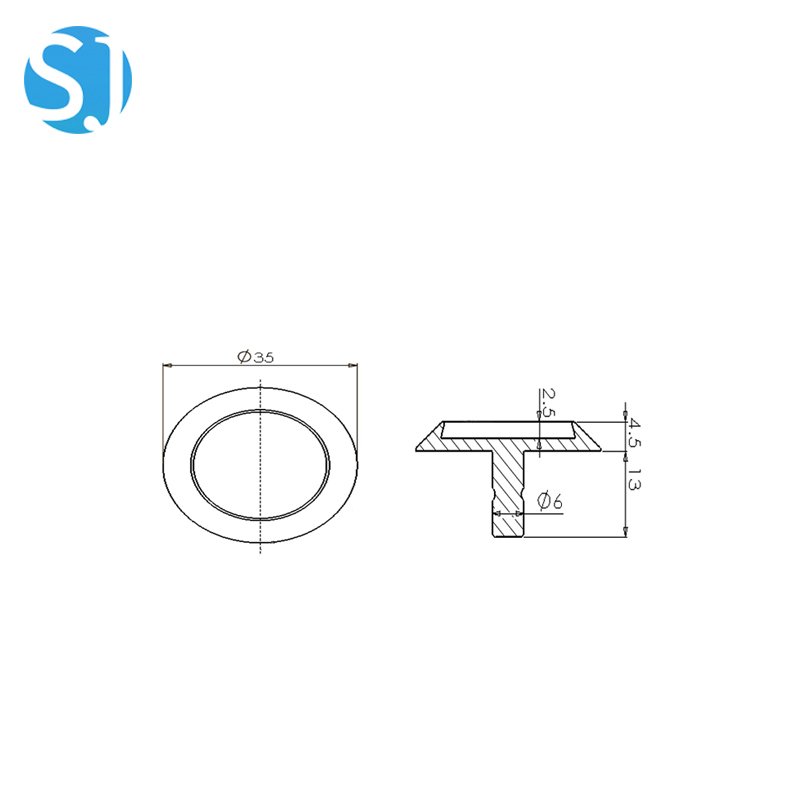
Product Features
· Rubber or polyurethane (PU) insert in the dome face — softer contact surface; significantly reduced cane-tap noise compared to bare stainless steel
· SUS304 or SUS316L stainless steel base — full corrosion resistance and structural durability
· One-piece stamping with insert — no assembly joints
· Primary specification for noise-sensitive indoor environments — hospital wards, libraries, hotel lobbies, gallery spaces, courts and tribunals
· Provides full TGSI dome height compliance — rubber insert does not reduce dome height below standard minimum
· Softer underfoot sensation for users with thin-soled footwear or bare feet
· Available in 25mm, 30mm and 35mm diameter
Product Specifications
| Model | Rubber PU Insert Surface Tactile Stud |
| Type | Dome Warning Indicator — Dot / Hazard Warning Pattern |
| Material | SUS304 or SUS316L Stainless Steel Base + Rubber or PU Insert |
| Construction | One-Piece Stamping with Rubber/PU Insert |
| Surface Finish | Rubber / PU Insert Dome Face |
| Available Diameters | 25mm / 30mm / 35mm |
| Dome Height | Per ADA / AS/NZS / EN Standards (Insert Does Not Reduce Dome Height) |
| Installation Method | Embedded Drill-and-Fix / Epoxy Adhesive Surface Mount |
| Compatible Substrates | Concrete, Stone, Tile, Terrazzo |
| Standards Compliance | ADA / AS/NZS 1428.4.1 / EN 15209 / ISO 23599 |
| MOQ | By Quantity — Project Order |
| Lead Time | 15–20 Business Days |
Applications
· Hospital ward corridors and clinical areas — rubber insert eliminates the repetitive cane-tap noise that would disturb patients; especially important in overnight care wards and ICU corridors
· Libraries and reading rooms — quiet tactile indicators for public libraries where noise control is a priority
· Luxury hotels — lobby and corridor warning studs that do not create disruptive noise in the hotel's acoustic environment
· Museum galleries and exhibition spaces — acoustic sensitivity is high; rubber studs allow TGSI compliance without audio disruption
· Courts and tribunal buildings — quiet indoor environments where the repeated sound of cane contact on metal studs would be audible and disruptive
· Places of worship — chapels, mosques, temples and other quiet indoor spaces requiring accessible warning indicators
· Theatres and performing arts venues — backstage and front-of-house areas where cane noise would be problematic
Product Advantages
· Acoustic performance — the rubber/PU insert reduces cane-tap noise by an estimated 60–70% compared to bare stainless steel; the primary functional advantage of this finish
· Comfortable tactile detection — the slightly yielding rubber surface provides a more comfortable underfoot tactile sensation for users with sensitive feet or thin-soled footwear
· Stainless steel durability with rubber acoustics — the structural base remains stainless steel; full corrosion resistance and long service life are maintained; only the tactile contact surface is softer
FAQ
Q: Is the rubber insert as durable as the stainless steel surface?
A: The rubber/PU insert is the surface element most subject to wear. Under heavy foot traffic, the rubber insert will eventually wear flat and require replacement of the stud. In very high-traffic areas, this limits the service life advantage of stainless steel. Rubber/PU insert studs are therefore recommended for indoor, moderate-traffic environments — not for the highest-traffic outdoor installations where checker diamond or carborundum would provide much longer service life.
Q: Does the rubber insert meet TGSI compliance requirements?
A: Yes. The rubber/PU insert maintains the required dome height and profile geometry. TGSI standards specify dome dimensions (height, base diameter, spacing) — they do not specify surface material. A rubber-topped dome that meets the dimension requirements is fully compliant.
Q: What is the difference between rubber and PU insert?
A: Both provide similar acoustic and tactile properties. Rubber inserts tend to be slightly softer with a higher damping effect. PU (polyurethane) inserts are more resilient and have slightly better wear resistance than natural rubber under sustained foot traffic. For most applications, both perform equivalently.


