Product Features
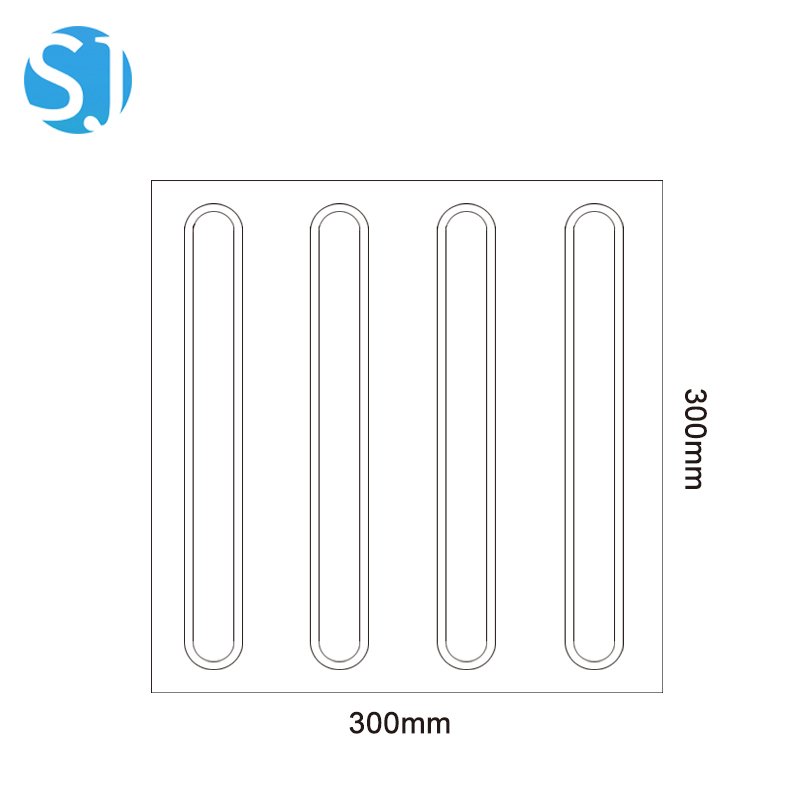
· Raised bar (corduroy) pattern — directional guidance TGSI function; bars run parallel to the intended direction of pedestrian travel
· TPU material — highest polymer durability; recommended for outdoor and high-traffic directional guidance paths
· Bar dimensions compliant with ADA, ASTM, EN and ISO standards
· UV-resistant and weather-resistant — colour-stable for outdoor guide path installations
· Slip-resistant raised bar surface
· Flexible — accommodates minor substrate irregularities
· Standard 300×300mm panel
· Yellow (standard), black, grey, red and custom colours
· Designed to be paired with MD-00T dot pattern tiles for a complete matched TPU TGSI system
Product Specifications
| Model | MD-01T |
| Pattern | Bar / Corduroy — Directional Guidance |
| Material | TPU (Thermoplastic Polyurethane) |
| Panel Dimensions | 300 × 300 mm |
| Thickness | 5.0 mm |
| Bar Height | 4.7 mm |
| Bar Width / Spacing | Per ADA / ASTM / EN Standard |
| Colour Options | Yellow (Standard), Black, Grey, Red, Custom |
| Performance | Slip-Resistant, UV-Resistant, Weather-Resistant, Wear-Resistant |
| Standards Compliance | ADA / ASTM / EN / ISO / CSA / Title 24 |
| Installation Methods | Adhesive Bonding / Mechanical Fixing / Direct Surface-Mounted |
| Compatible Substrates | Concrete, Stone, Tile, Asphalt, Existing Floor Surfaces |
| MOQ | By m² / Project Quantity |
| Lead Time | 15–20 Business Days |
Applications
· Subway and metro station concourses — directional guidance paths from station entrances to platform access gates, lifts and exits
· Railway station buildings — guide paths through ticketing halls, waiting areas and platform connections
· Airport terminal buildings — pedestrian guidance paths for visually impaired passengers through check-in, security and boarding gate areas
· Pedestrian underpasses and overpasses — continuous directional guidance along pedestrian-only routes
· Hospital and healthcare facility corridors — guidance paths for visually impaired patients and visitors between key clinical areas
· Shopping centre main circulation routes — directional guidance along primary pedestrian spines from building entrances to lifts and escalators
· Educational campus outdoor paths — guidance paths between buildings and along primary pedestrian routes
· Government and civic building corridors — accessible wayfinding paths through public service areas
Installation Steps
1. Prepare and inspect the substrate — clean, dry, level and sound. New concrete minimum 28 days cured.
2. Plan the guide path route — confirm start and end points, mark the path centreline on the substrate. The guide path width (number of bar tile columns) should comply with the applicable TGSI standard.
3. Dry-lay tiles to confirm layout — pay particular attention to bar orientation. Bars must run parallel to the direction of travel. At direction changes, re-orient the tile grid to the new travel direction.
4. Apply adhesive — contact cement or epoxy tile adhesive to both substrate and tile underside. Allow to reach correct tack level.
5. Place tiles — start at one end of the guide path and work toward the far end. Maintain tight joints between adjacent tiles. Keep bar rows aligned and parallel across tile joints.
6. Bar orientation check — verify that bars in adjacent tiles align continuously across tile joints. Misaligned bars disrupt the tactile reading of the guidance path.
7. Roll with rubber roller for full contact bonding.
8. At junctions with hazard warning zones — install MD-00T dot pattern tiles at the junction to indicate a decision point or hazard transition.
9. Grout joints with colour-matched flexible grout.
10. Allow 24-hour cure before opening to foot traffic.
Product Advantages
· Complete TPU TGSI system — MD-01T bar + MD-00T dot creates a full matched guidance and warning system in a single material specification
· Highest outdoor guide path durability — TPU bar tile outlasts PVC in UV-exposed and high-traffic outdoor path applications; lower total replacement cost over project lifetime
· Continuous path capability — 300×300mm tile format allows guide paths of any length and configuration to be laid with consistent tile joints
FAQ
Q: How wide should a directional guidance path be?
A: The minimum guidance path width depends on the applicable standard. ADA guidelines and most international standards specify a minimum of two bar tile columns (600mm) for a functional guidance path that can be reliably detected underfoot and by long cane. Three columns (900mm) is recommended for primary guidance routes in high-traffic areas. Consult the applicable standard for your project jurisdiction.
Q: How do I handle a change of direction in the guidance path?
A: At a direction change, the bar tile grid is rotated to face the new direction of travel. A small section of dot pattern tiles (MD-00T) is typically placed at the point of direction change to indicate the decision point to the visually impaired pedestrian. The exact layout at direction changes should comply with the applicable TGSI standard.
Q: Can bar pattern tiles be installed on curved paths?
A: Standard 300×300mm square tiles create straight-line paths. For curved paths, tiles can be laid with small opening joints on the outside of the curve, provided the joint width remains within the standard's acceptable gap dimension (typically max 5mm). For tight curves, consult with your TGSI designer on the appropriate layout.


