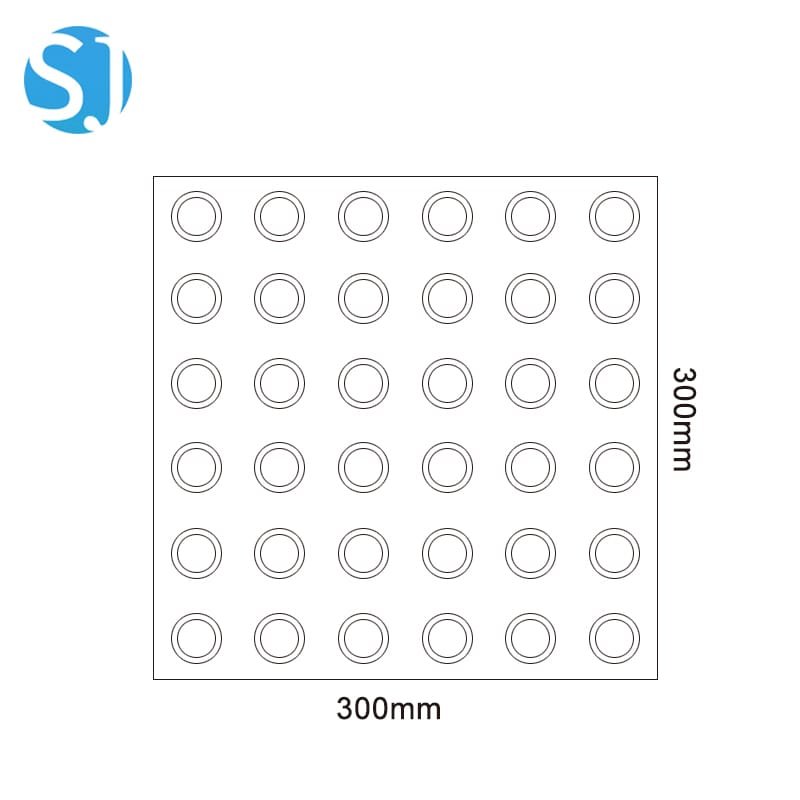
Product Features
· Raised dot (blister) pattern — standard hazard warning TGSI profile, detectable underfoot and by long cane
· TPU (Thermoplastic Polyurethane) material — superior abrasion resistance, flexibility and UV stability vs. standard PVC; recommended for high-traffic and outdoor installations
· Dome dimensions compliant with international standards — dome height 4.7mm, base diameter and spacing meet ADA, ASTM, EN, ISO, CSA and Title 24 requirements
· UV-resistant formulation — colour-stable for outdoor exposure; no chalking or fading under prolonged sunlight
· Slip-resistant surface — raised dome profile provides anti-slip traction in both wet and dry conditions
· Weather-resistant — maintains performance across wide temperature range; suitable for outdoor use in all climates
· Flexible construction — accommodates minor substrate surface irregularities without cracking or delamination
· Adhesive and mechanical fixing compatible — installs on concrete, tile, stone, asphalt and existing floor surfaces
· Available in yellow (standard), black, grey, red and custom colours
· Standard 300×300mm panel — compatible with all standard TGSI layout grids
Product Specifications
| Model | MD-00T |
| Pattern | Dot / Blister — Hazard Warning |
| Material | TPU (Thermoplastic Polyurethane) |
| Panel Dimensions | 300 × 300 mm |
| Thickness | 5.0 mm |
| Dome Height | 4.7 mm |
| Dome Base Diameter | Per ADA / ASTM / EN Standard |
| Dome Spacing | Per ADA / ASTM / EN Standard |
| Colour Options | Yellow (Standard), Black, Grey, Red, Custom |
| Performance | Slip-Resistant, UV-Resistant, Weather-Resistant, Wear-Resistant, Impact-Resistant |
| Standards Compliance | ADA / ASTM / EN / ISO / CSA / Title 24 |
| Installation Methods | Adhesive Bonding / Mechanical Fixing / Direct Surface-Mounted |
| Compatible Substrates | Concrete, Stone, Tile, Asphalt, Existing Floor Surfaces |
| MOQ | By m² / Project Quantity |
| Lead Time | 15–20 Business Days After Order Confirmation |
Applications
· Subway and metro platform edges — hazard warning strip at the prescribed distance from the platform edge; high-traffic heavy-duty outdoor use
· Railway station platforms and concourses — platform edge warning and approach zone indicators
· Pedestrian crossing approach zones — hazard warning grid across the full footpath width approaching vehicle crossings and signalised intersections
· Curb ramp (dropped kerb) heads — warning zone at the top of curb cuts where the footpath transitions to the roadway
· Bus terminal entry zones — warning indicators at bus bay kerb edges and terminal building entrances
· Building entrance thresholds — hazard warning at level changes, door thresholds and entrance transitions
· Stairway heads and bases in public buildings — warning indicator at the top and bottom of stairways in transit facilities, offices and institutions
· Shopping centre and retail environments — high-traffic indoor TGSI with heavy pedestrian and cleaning equipment loads
· Hospitals and healthcare facilities — outdoor approach zones and high-footfall entrance areas
· Schools and educational campuses — outdoor pedestrian crossing points and stair heads on campus
Installation Steps
1. Substrate preparation — ensure the installation surface is clean, dry, level and free from dust, grease, old adhesive and loose material. Grind down surface irregularities greater than 3mm and fill depressions. The substrate must be structurally sound and fully cured (minimum 28 days for new concrete).
2. Dry-lay trial — place tiles in the planned pattern without adhesive to confirm layout alignment, visual appearance and compliance with the applicable TGSI standard spacing requirements before fixing.
3. Adhesive application (adhesive method) — apply contact cement, epoxy tile adhesive or polyurethane construction adhesive to both the substrate surface and the underside of the tile. Allow the adhesive to reach the correct tack level per the manufacturer's instructions (typically 5–15 minutes for contact cement).
4. Tile placement — press each tile firmly into position. Work from one end of the installation area toward the other to avoid trapping air or displacing adhesive. Align tile edges squarely with adjacent tiles and with the pedestrian travel direction.
5. Dot orientation — for dot pattern tiles, ensure the dome grid is square to the pedestrian direction of travel. The dome rows should run parallel and perpendicular to the direction of approach.
6. Rolling — immediately after placing each tile, roll the full tile surface with a rubber-faced roller (minimum 30kg) to ensure full contact bonding across the entire underside. Pay particular attention to tile edges and corners.
7. Mechanical fixing (mechanical method) — drill countersunk pilot holes at the marked positions through the tile and into the substrate. Use masonry anchors for concrete substrates. Insert countersunk stainless steel screws and tighten flush. Fill screw heads with colour-matched epoxy filler.
8. Joint grouting — fill the narrow joint gap between adjacent tiles with colour-matched flexible grout. Do not use rigid cement grout, which will crack under thermal movement.
9. Curing — allow the adhesive to cure for a minimum of 24 hours (72 hours for full cure in cold conditions) before the installation area is opened to pedestrian traffic. Avoid foot traffic, water and cleaning during cure.
10. Inspection — after curing, verify that all tiles are firmly bonded with no hollow spots (tap test), no raised edges, and that the installation meets the required TGSI pattern dimensions per the applicable standard.
Product Advantages
· Best-in-class polymer durability — TPU material provides significantly longer service life than standard PVC under high-traffic and outdoor conditions; lower lifetime replacement cost
· Full international standard compliance — ADA, ASTM, EN, ISO, CSA and Title 24 compliance from a single product; suitable for projects in North America, Europe, Australia and international markets
· Simple installation on existing surfaces — adhesive bonding method installs directly over existing concrete, tile or stone without substrate demolition; ideal for retrofit and refurbishment projects
· Colour system flexibility — available in yellow, black, grey, red and custom colours; single supplier for all colour variants in a consistent material specification
· Factory-direct pricing — manufactured in-house; competitive B2B unit costs for large-scale infrastructure and fit-out projects
· Complete TGSI system from one supplier — MD-00T pairs directly with MD-01T bar pattern tile for a matched warning + guidance system; stainless steel alternatives (SSTP-00) available from the same manufacturer
FAQ
Q: Why should I choose TPU (MD-00T) instead of PVC (MD-00P) for my project?
A: TPU provides significantly better abrasion resistance, impact resistance and long-term UV colour stability than PVC. Under heavy pedestrian traffic and outdoor exposure, TPU tiles maintain their profile and colour far longer than equivalent PVC tiles. For high-traffic transit environments (subway stations, airports, transport hubs) and outdoor installations, TPU is the recommended specification. PVC (MD-00P) is the cost-effective choice for indoor and light-traffic applications where budget is the priority.
Q: What adhesive should be used to install the MD-00T?
A: For concrete and stone substrates, two-component epoxy tile adhesive or polyurethane construction adhesive is recommended for permanent installation. Contact cement (neoprene-based) is suitable for medium-duty indoor applications. For outdoor installations, use a weatherproof adhesive rated for the expected temperature range and freeze-thaw cycling. All adhesives must be compatible with TPU — solvent-based adhesives that attack TPU should not be used.
Q: Is MD-00T suitable for installation on existing asphalt surfaces?
A: Yes. The MD-00T can be adhesive-bonded to sound asphalt surfaces using flexible polyurethane or bitumen-compatible adhesive. The substrate must be clean, dry and free from surface deterioration. In high-temperature climates where asphalt softens in summer sun, mechanical fixing is recommended as a supplementary fixing method.
Q: What is the difference between the dot pattern and bar pattern tiles?
A: Dot (blister) pattern tiles (MD-00T) are hazard warning indicators — they alert visually impaired pedestrians that they are approaching a hazard such as a platform edge, road crossing or stair head. Bar (corduroy) pattern tiles (MD-01T) are directional guidance indicators — they create the guide path that directs pedestrians along a safe route. Both types are required in a complete TGSI installation.
Q: How do I calculate how many tiles I need?
A: At the standard 300×300mm panel size, approximately 11 tiles cover 1 square metre. For a standard platform edge warning strip of 600mm depth × 10m length, you would need approximately 22 tiles per row × 2 rows = 44 tiles, plus 10% contingency. Contact us with your project layout dimensions and we will calculate the exact tile quantity required.
Q: Can tiles be cut to fit at edges and boundaries?
A: Yes. TPU tiles can be cut to size on-site using a sharp utility knife or jigsaw with a fine-tooth blade. Score the cut line on the tile face and cut from the back side for the cleanest edge. Note that cut tiles should be positioned at the edge of the installation, not at junctions between tiles, to maintain the TGSI pattern integrity.


