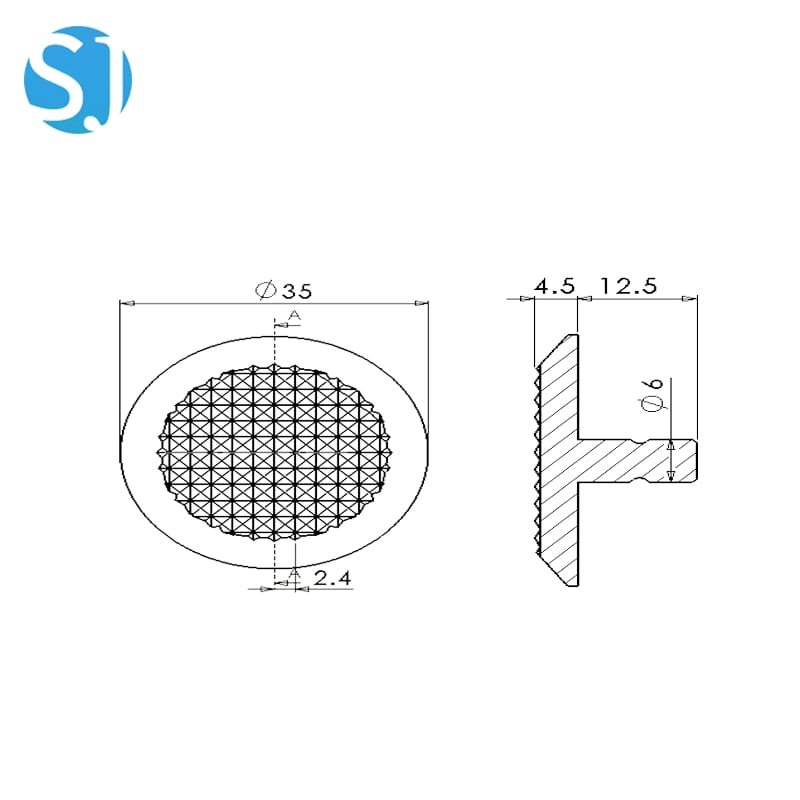
Product Features
· Checker diamond surface pattern — deep interlocking diamond-cut texture on the dome face; maximum anti-slip traction and visual contrast
· SUS304 or SUS316L stainless steel — specify 316L for coastal, waterfront, food service and high-humidity environments
· One-piece stamping — single-piece construction with no assembly joints; full structural integrity
· Highest grip rating in the stud range — deep diamond cut provides maximum wet-condition slip resistance; recommended for outdoor and exposed environments
· Strong visual contrast — patterned dome surface reads clearly against concrete, stone and tile floor finishes under all lighting conditions
· Embedded drill-and-fix or surface adhesive installation
· Compatible with all hard floor substrates: concrete, stone, tile, asphalt, metal floor plates
· TGSI dome dimension compliant — dome height and base diameter meet ADA, AS/NZS and EN requirements
· Available in 25mm, 30mm and 35mm diameter (confirm available sizes on order)
Product Specifications
| Model | Checker Diamond Pattern Tactile Stud |
| Type | Dome warning indicator — dot / hazard warning pattern |
| Material | SUS304 or SUS316L stainless steel |
| Construction | One-piece stamping |
| Surface finish | Checker diamond pattern |
| Available diameters | 25mm / 30mm / 35mm |
| Dome height | Per ADA / AS/NZS / EN standard specification |
| Shank type | Expansion anchor shank (embedded) or flat base (adhesive) |
| Installation method | Embedded drill-and-fix / epoxy adhesive surface mount |
| Compatible substrates | Concrete, stone, tile, asphalt, metal |
| Standards compliance | ADA / AS/NZS 1428.4.1 / EN 15209 / ISO 23599 |
| MOQ | By quantity — project order |
| Lead time | 15–20 business days |
Applications
· Subway and metro platform edges (outdoor / semi-outdoor) — warning grid at the prescribed distance from the platform hazard edge; withstands rain, cleaning and heavy foot traffic
· External pedestrian crossing approach zones — street-level stud warning grids in exposed outdoor footpath environments
· External stair heads and bases in public buildings and transit facilities — warning stud grid at the top and bottom of outdoor stairways
· Curb ramp (dropped kerb) heads on public footpaths — flush-embedded studs in concrete or asphalt at the top of curb cuts
· Port and marine terminal pedestrian areas — SUS316L for continuous salt-air exposure
· Sports venue outdoor concourse stair heads — heavy intermittent crowd loads on outdoor concrete
· Exposed ramp approach zones in public buildings — warning grid at the head of outdoor accessible ramps
Product Advantages
· Maximum wet-condition grip — the deep checker diamond pattern provides greater slip resistance than any other stud surface finish; essential for outdoor environments where wet, frost or algae risk is present
· Permanent corrosion-free service — SUS304 or 316L eliminates rust or staining on surrounding floor surfaces; required for outdoor concrete and stone installations
· High visual contrast for accessibility — the patterned dome surface provides strong contrast against flat floor finishes, improving step detection for people with low vision in addition to tactile detection
· System matched to checker diamond tactile bar — pairs with the checker diamond tactile bar for a consistent anti-slip finish across the complete outdoor TGSI system
FAQ
Q: Why is the checker diamond pattern recommended for outdoor rather than indoor use?
A: The deep diamond-cut texture of the checker diamond pattern provides the highest anti-slip coefficient of all stud surface finishes — particularly important in outdoor environments where rain, frost, algae and dirt reduce the natural friction of floor surfaces. For indoor environments in heated, climate-controlled buildings, the deep texture is not necessary and a plain flat, ring grooved or rubber/PU insert finish may be more appropriate for aesthetic reasons.
Q: What stud diameter should I specify?
A: Stud diameter must match the grid spacing requirements of your applicable TGSI standard. For ADA compliance, dome base diameter and spacing are specified in the ADA Standards for Accessible Design Section 705. For AS/NZS 1428.4.1, dome dimensions are specified in Table 1. As a general guide, 25mm diameter studs are used with tighter spacing; 35mm diameter studs with wider spacing. Confirm your standard's requirements before ordering.
Q: How close to the hazard edge should the stud warning grid be installed?
A: The hazard approach distance (distance from the nearest stud row to the hazard edge) is defined by the applicable standard. For ADA, the detectable warning surface must be placed within 6–8 inches (150–200mm) of the hazard edge. For AS/NZS 1428.4.1, specific approach distances are defined for different hazard types. Confirm the required distance from your project's applicable standard.
Q: Can checker diamond studs be used indoors?
A: Yes — the checker diamond finish provides excellent TGSI performance indoors. The main reason to consider alternatives for indoor use is aesthetic: the deep diamond pattern has a more industrial appearance than the plain flat or ring grooved options. For high-specification architectural interiors, a plain flat or anti-fingerprint finish stud may integrate better with the floor design.


