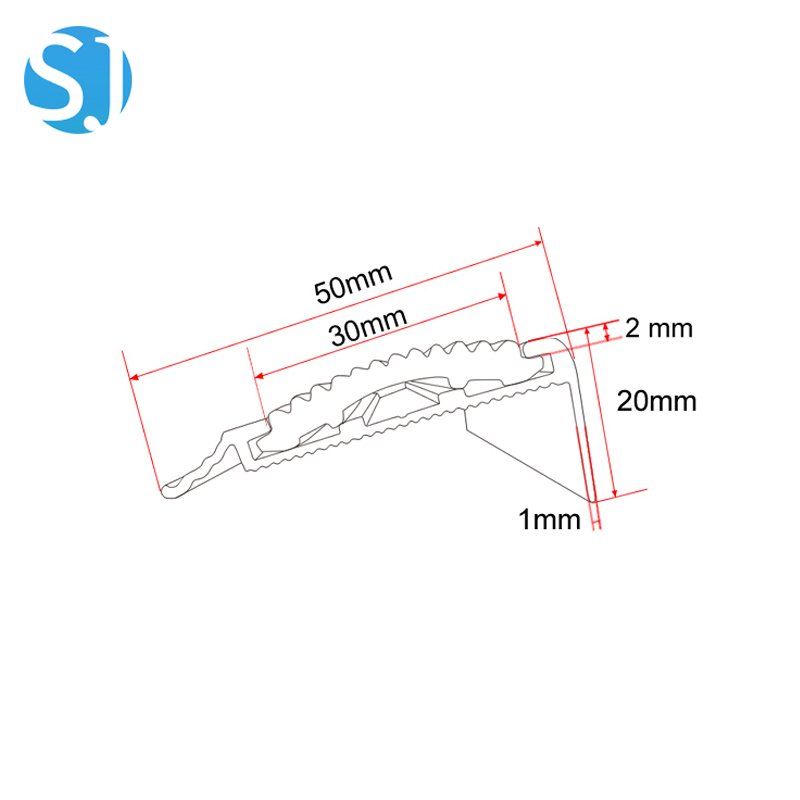
The aluminium profile is anodized or powder-coated for long-term corrosion resistance, making the D50 appropriate for both indoor and outdoor stair applications including concrete staircases, tiled steps and vinyl plank stair installations.
Product Features· 50mm aluminium base — industry-standard width for commercial stair tread edge protection
· Replaceable anti-slip PVC insert — maintains slip resistance without replacing the full profile; reduces maintenance cost
· High-visibility contrasting insert — yellow, grey or black PVC available; yellow insert meets high-visibility safety marking requirements for public buildings
· Anodized or sandblasted aluminium finish — corrosion-resistant surface suitable for indoor and outdoor use
· Pre-drilled countersunk fixing holes — for fast, secure installation with standard screws
· Compatible with concrete, tile, stone, vinyl, LVT/LVP and timber treads
· Custom cut lengths available — supplied to your specified dimensions; no on-site cutting required
Product Specifications
| Specification | Detail |
|---|
| Model | D50 |
| Type | Aluminium + PVC Insert Stair Nosing |
| Material | Aluminium Alloy Base + PVC Anti-Slip Insert |
| Width | 50 mm |
| Height / Thickness | 20 mm |
| Surface Finish | Anodized or Sandblasted |
| PVC Insert Colours | Yellow, Grey, Black |
| Aluminium Colour | Silver (Standard), Black, Gold |
| Anti-Slip Method | Textured PVC Insert |
| Fixing Method | Countersunk Screws (Pre-Drilled) |
| Standard Lengths | 1 m, 1.5 m, 2 m, 2.5 m / Custom |
| Compatible Substrates | Concrete, Tile, Stone, Vinyl, LVT, LVP, Timber |
| Applications | Commercial Buildings, Schools, Hospitals, Transport Hubs, Shopping Centres |
| MOQ | By Linear Metre |
| Lead Time | 15–20 Business Days |
Applications
· Commercial office buildings — stair edge protection in lobbies and communal stairwells
· Schools and educational facilities — high-visibility yellow insert meets school building safety standards
· Hospitals and healthcare facilities — non-slip stair edge trim in high-footfall stairwells; compatible with infection control cleaning agents
· Shopping centres and retail environments — durable stair edge protection in high-traffic areas
· Transportation hubs — airports, train stations and bus terminals requiring robust anti-slip stair nosing for continuous heavy use
· Public buildings and government facilities — stair nosing meeting building codes for anti-slip performance and step visibility
· Outdoor concrete stairs — anodized finish provides corrosion resistance for exterior applications
· Renovation and refurbishment projects — can be retrofitted onto existing concrete, tile or vinyl stair treads without stair reconstruction
Installation Steps1. Measure the stair tread width and determine the required nosing length. Order D50 in the specified length to avoid on-site cuts, or mark and cut with a metal saw if trimming is required.
2. Clean the stair tread edge — remove any existing nosing, adhesive residue or debris from the installation surface.
3. Position the D50 nosing at the front edge of the tread. The aluminium profile should sit flush with the tread surface with the PVC insert facing outward toward the step face.
4. Mark fixing hole positions through the pre-drilled countersunk holes in the aluminium base.
5. Drill pilot holes at the marked positions using a drill bit appropriate for your substrate (masonry bit for concrete, standard bit for timber).
6. Fix the nosing to the tread using countersunk screws (supplied). Tighten firmly but do not overtighten — the aluminium base should sit flat and flush with no gaps.
7. Press the PVC anti-slip insert into the aluminium channel if not pre-installed. The insert snaps into the groove in the aluminium base.
8. Repeat for all steps. Check that each nosing is level and flush before moving to the next step.
Note: For concrete stairs, use masonry anchor screws (supplied) for a secure fixing that does not require adhesive.
Product Advantages· Replaceable PVC insert — when the anti-slip insert wears, replace only the insert, not the full nosing; significant cost saving over full-profile replacement
· High-visibility option — yellow PVC insert provides the highest visibility step edge marking for building safety compliance
· Factory-direct pricing — competitive B2B rates for contractor and distributor orders; volume pricing available
· Pre-drilled, ready to install — no on-site drilling of the aluminium profile required
· One supplier for all stair types — D50 is compatible with the widest range of stair substrates of any profile in our range
FAQ
Q: Can the PVC insert be replaced without removing the aluminium base?
A: Yes. The PVC insert clips into a channel in the aluminium base. When the insert wears, it can be removed and a new insert snapped in place without removing the screws or disturbing the aluminium base fixed to the stair.
Q: Is the yellow insert suitable for ADA / DDA compliance?
A: The yellow high-contrast PVC insert meets the step-edge contrast requirements specified in many building codes and accessibility standards (including ADA, DDA and AS 1428.1). Please confirm the specific standard required for your project — we can provide product specifications and test documentation on request.
Q: What is the load-bearing capacity of the D50?
A: The D50 50mm aluminium profile is rated for standard commercial pedestrian stair use including high-traffic public buildings. For industrial stair applications with wheeled equipment or heavy mechanical loads, we recommend the D60 or A70 models.
Q: Can D50 be used on outdoor concrete stairs?
A: Yes. The anodized or powder-coated aluminium finish provides corrosion resistance for outdoor use. Use stainless steel or zinc-plated screws for outdoor fixings to prevent rust staining on the concrete.
Q: Is D50 available in black?
A: Yes. The aluminium base is available in silver (standard), black and gold. The PVC insert is available in yellow, grey or black independently of the aluminium colour.


